
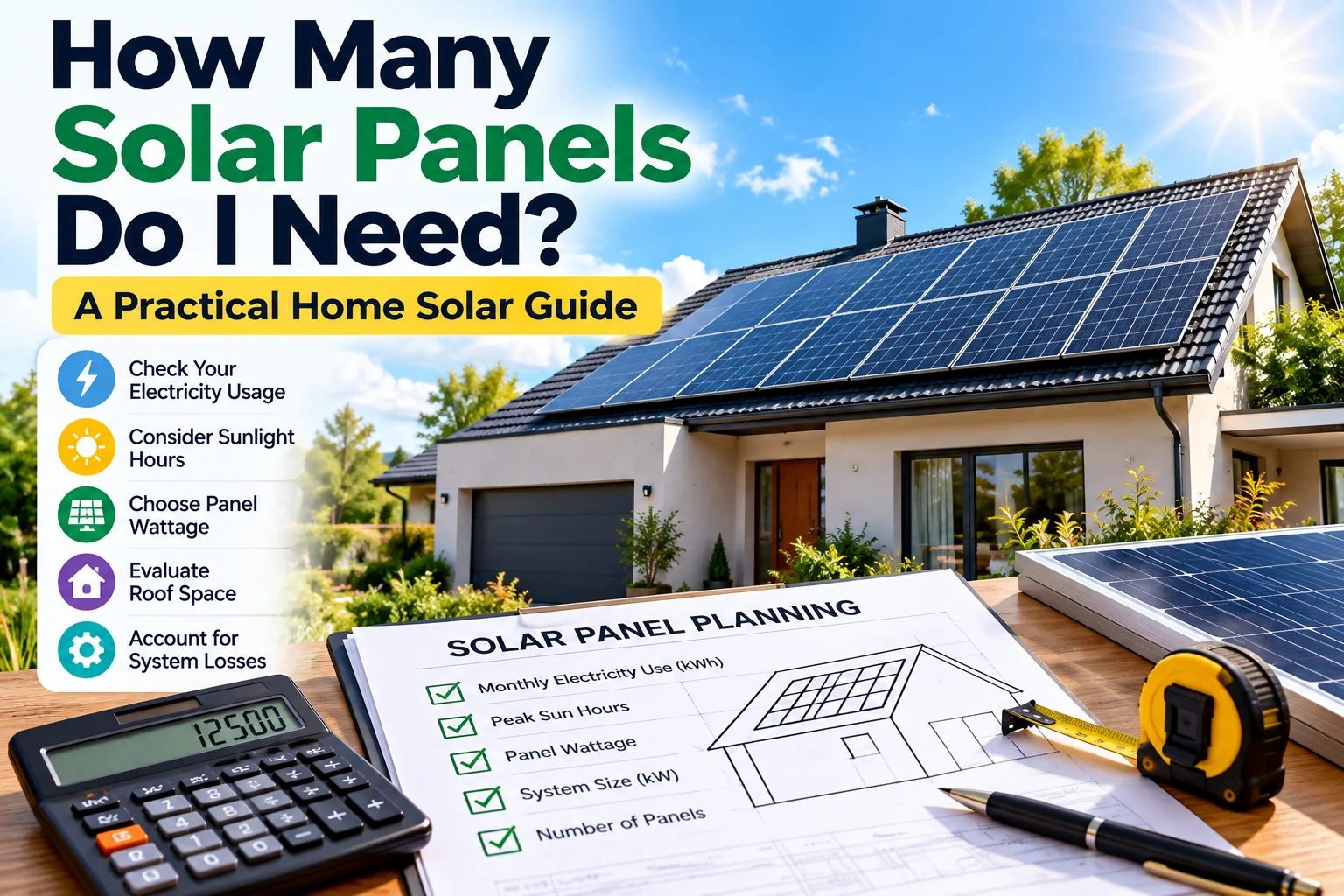
One of the first questions people ask when considering solar power is simple: How many solar panels do I need?
The answer depends on more than the size of your home. Two houses of the same size can use very different amounts of electricity. Climate, appliances, heating and cooling, household size, panel wattage, roof conditions, and available sunlight all influence the final system size.
A useful starting point is your actual electricity consumption. From there, you can estimate the solar system capacity needed to produce a similar amount of energy and then convert that capacity into an approximate number of panels.
This guide walks through that process step by step.
Start With Your Electricity Usage
The most useful number for a basic solar estimate is your electricity consumption in kilowatt-hours (kWh).
Your electricity bill will normally show how many kWh you used during the billing period.
For example, suppose a household uses:
900 kWh per month
An approximate annual consumption would be:
900 × 12 = 10,800 kWh per year
However, electricity use often changes throughout the year. Air conditioning, electric heating, holidays, and seasonal changes can make some months much higher than others.
If you have access to 12 months of bills, adding the actual monthly usage gives a better picture than multiplying a single month by 12.
What Is a Kilowatt-Hour?
A kilowatt-hour measures energy consumption.
If a 1,000-watt appliance operates for one hour, it uses:
1 kilowatt-hour (1 kWh)
Solar panels are usually rated in watts (W), while household electricity consumption is generally measured in kilowatt-hours (kWh).
These are related but not interchangeable.
Panel wattage tells you the panel's rated power under specified test conditions. Actual energy production depends on sunlight, temperature, orientation, shading, equipment efficiency, and other conditions.
What Are Peak Sun Hours?
Solar calculations often use peak sun hours rather than simply counting the number of daylight hours.
A peak sun hour represents an amount of solar energy equivalent to one hour at a solar irradiance of 1,000 watts per square meter.
A location might have many hours of daylight but only a smaller number of equivalent peak sun hours.
For example, if an area averages 5 peak sun hours per day, a simplified estimate for a 400-watt panel would begin with:
400 W × 5 hours = 2,000 Wh
or:
2 kWh per day
That is a theoretical starting point before accounting for real-world system losses.
Basic Solar System Size Formula
A simplified way to estimate the required solar capacity is:
Required Solar Capacity (kW) = Daily Electricity Use (kWh) ÷ Peak Sun Hours
Suppose a home uses:
900 kWh per month
Using a simplified 30-day month:
900 ÷ 30 = 30 kWh per day
If the location receives an average of 5 peak sun hours per day:
30 ÷ 5 = 6 kW
In an idealized calculation, approximately 6 kW of solar capacity would produce 30 kWh during 5 equivalent peak sun hours.
Real systems, however, do not operate under ideal conditions all the time.
Account for Real-World System Losses
Solar systems can lose some potential production because of factors such as:
- Inverter efficiency
- Wiring losses
- Panel temperature
- Dust and dirt
- Shading
- Panel orientation
- Equipment tolerances
- Other system conditions
A simplified estimate can account for these effects using a system efficiency or derating factor.
For example, using an illustrative factor of 80%, the calculation becomes:
Required Capacity = Daily Usage ÷ (Peak Sun Hours × 0.80)
Using the same 30 kWh daily consumption and 5 peak sun hours:
30 ÷ (5 × 0.80) = 7.5 kW
This produces an estimated system size of approximately 7.5 kW.
The 80% factor is only an example for planning. Actual expected system performance should be based on the specific location, equipment, design, and professional production modeling.
Convert System Size Into Number of Panels
Once you have an estimated system capacity, you can convert it into a panel count.
Use:
Number of Panels = Required System Watts ÷ Panel Wattage
Suppose the estimated system size is:
7.5 kW
Convert kilowatts to watts:
7.5 × 1,000 = 7,500 W
If each solar panel is rated at 400 W:
7,500 ÷ 400 = 18.75
Since you cannot install 0.75 of a standard panel, this example would round to approximately:
19 panels
The resulting nominal array size would be:
19 × 400 W = 7,600 W
or:
7.6 kW
Complete Example
| Item | Example |
|---|---|
| Monthly Electricity Use | 900 kWh |
| Approx. Daily Use | 30 kWh |
| Peak Sun Hours | 5 |
| Illustrative System Factor | 80% |
| Estimated System Size | 7.5 kW |
| Panel Rating | 400 W |
| Estimated Panel Count | 19 |
| Nominal Array Size | 7.6 kW |
This is a planning estimate, not a final solar design.
A professional design may produce a different result after considering the roof, local solar resource, shading, electrical requirements, utility rules, equipment specifications, and desired level of energy offset.
Why Panel Wattage Matters
Higher-wattage panels can reduce the number of panels required for a given nominal system capacity.
For example, suppose you need approximately 7,500 watts of panel capacity.
Using 350 W panels:
7,500 ÷ 350 ≈ 21.43
Approximately 22 panels.
Using 400 W panels:
7,500 ÷ 400 = 18.75
Approximately 19 panels.
Using 450 W panels:
7,500 ÷ 450 ≈ 16.67
Approximately 17 panels.
Higher wattage does not automatically mean a particular panel is the best choice. Panel dimensions, efficiency, price, warranty, roof layout, electrical design, and availability also matter.
How Much Roof Space Do Solar Panels Need?
The number of panels is only part of the calculation. They also need to fit in usable areas.
Roof space may be reduced by chimneys, skylights, vents, roof edges, shaded areas, different roof sections, required access or setbacks, and local building or fire requirements.
Panel dimensions vary by model, so estimating roof space from panel count alone can be misleading.
For a more realistic layout, use the actual length and width of the panel being considered and compare those dimensions with the usable roof area.
A roof may have enough total square footage but still be unable to fit the desired number of panels because of its shape or obstructions.
Roof Direction and Tilt
The direction and angle of a solar array affect how much sunlight reaches the panels.
The best orientation varies by geographic location, roof geometry, energy-use pattern, and system goals.
A roof section that receives strong sunlight for much of the day may produce more energy than a similarly sized section with poor orientation or significant shading.
This means two homes using the same amount of electricity may need different solar designs.
Shading Can Change the Estimate
Trees, nearby buildings, chimneys, and other obstructions can reduce solar production.
Shading may also change during the day and throughout the year as the sun's position changes.
If part of a roof receives substantial shade, simply adding more panels without understanding the shading pattern may not be the best solution.
A professional site assessment can evaluate how much usable solar exposure different roof areas receive.
Do You Need to Offset 100% of Your Electricity?
Not every solar system needs to produce an amount equal to the home's entire annual electricity consumption.
Some homeowners may choose a smaller system because of limited roof space, budget constraints, utility rules, future energy plans, system economics, shading, or local interconnection limits.
Others may be planning for higher future electricity consumption.
For example, adding an electric vehicle, heat pump, electric water heater, home office, pool equipment, or another major electrical load could increase future usage.
When estimating a system, consider whether your current electricity bills represent how you expect to use energy over the next several years.
Solar Panels and Battery Storage Are Different Calculations
The number of solar panels and the amount of battery storage are related, but they answer different questions.
Solar panel sizing focuses mainly on energy generation.
Battery sizing focuses on energy storage, backup requirements, discharge limits, desired backup duration, and which electrical loads you want to support.
A home may have a large solar array and no battery, or a solar-plus-storage system designed around specific backup goals.
Do not assume that calculating the number of panels automatically determines the correct battery capacity.
Grid-Tied Solar Does Not Always Eliminate the Electricity Bill
Producing solar electricity does not necessarily mean your utility bill will become zero.
Depending on the location and utility, a bill may still include fixed service charges, minimum charges, taxes, grid usage charges, imported electricity, or other fees.
The financial value of exported solar electricity also depends on the utility's applicable billing and compensation rules.
For this reason, estimating energy production and estimating bill savings should be treated as related but separate calculations.
Should You Use Your Highest-Usage Month?
Using only the highest electricity bill can oversize a basic estimate if that month is not representative of the rest of the year.
Using only the lowest month can have the opposite effect.
For a more balanced estimate, review a full year of electricity consumption when possible.
Add the kWh from all 12 months to determine annual consumption:
Annual Usage = Month 1 + Month 2 + ... + Month 12
Then divide by 365 for an approximate daily average if your calculation uses daily production.
This approach captures seasonal changes better than relying on a single bill.
Common Solar Sizing Mistakes
Using the Electricity Bill Amount Instead of kWh
The amount you pay in dollars is not the same as the amount of electricity you consume.
Solar sizing should generally start with energy usage in kWh, not the monetary total on the bill.
Treating Daylight Hours as Peak Sun Hours
A location can have 12 hours of daylight without receiving 12 peak sun hours.
Use appropriate solar resource data for the location.
Ignoring System Losses
A calculation based entirely on panel nameplate wattage and ideal sunlight may overestimate real-world energy production.
Ignoring Roof Limitations
The mathematical panel count may not physically fit on the usable roof.
Assuming a 400 W Panel Produces 400 W All Day
A 400 W rating is not a promise of continuous 400 W output throughout daylight hours. Solar production changes with environmental and operating conditions.
Forgetting Future Electricity Use
If your household expects a major change in electrical consumption, historical bills may not fully represent future needs.
Use a Solar Panel Calculator
You can make a rough estimate manually, but a calculator makes it easier to compare different scenarios.
The ZU Calculator Solar Panel Calculator can help you estimate solar requirements using your electricity consumption and relevant system inputs.
Try comparing different panel wattages or sunlight assumptions to see how the estimated panel count changes.
For example, compare 350 W, 400 W, and 450 W panels while keeping the household energy requirement the same. This helps show the relationship between individual panel capacity and total panel count.
Frequently Asked Questions
How do I estimate how many solar panels I need?
Start with your electricity consumption in kWh, estimate the solar system capacity needed for your location, account for realistic system performance, and divide the required system wattage by the wattage of each panel.
Can I calculate solar panels from my monthly electricity bill?
Yes, if the bill shows your electricity usage in kWh. Using 12 months of consumption is generally more representative than relying on one month.
Does a bigger house always need more solar panels?
No. Electricity consumption matters more than house size alone. A smaller home with high electricity use may need more solar capacity than a larger, energy-efficient home.
Do higher-wattage panels mean I need fewer panels?
For the same target nominal system capacity, higher-wattage panels generally reduce the number of panels required. Roof layout and other design factors still matter.
Will solar panels completely eliminate my electricity bill?
Not necessarily. Utility billing rules, fixed charges, energy imports, export compensation, system production, and household consumption all affect the final bill.
Should I include a battery when calculating solar panel requirements?
Battery capacity is a separate calculation. Solar panels determine generation capacity, while batteries store energy for later use or backup.
Final Thoughts
Estimating how many solar panels you need begins with understanding how much electricity you actually use.
Review your kWh consumption, consider the solar resource available at your location, account for realistic system performance, and then divide the required capacity by the wattage of the panels you are considering.
The result is a useful starting estimate, but the final system should also account for roof space, orientation, shading, electrical design, local requirements, and your future energy plans.
A good solar estimate is not simply about fitting the largest possible number of panels on a roof. It is about matching expected energy production with your household's needs and the practical limits of the property.
Note: Solar calculations are estimates for informational and planning purposes. Actual system size, production, savings, equipment requirements, and installation design depend on the property, location, weather, equipment, utility rules, and applicable electrical and building requirements.