
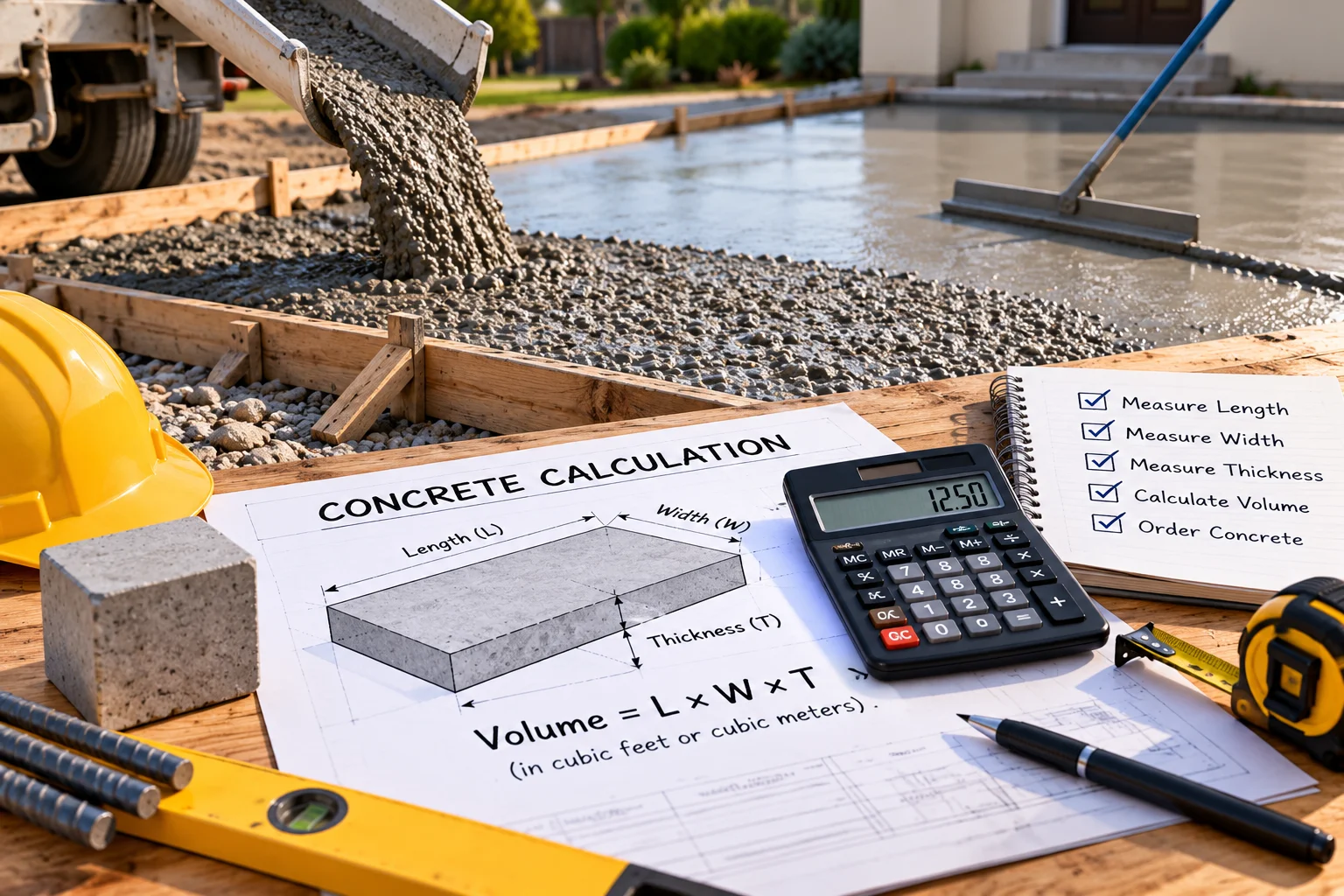
Ordering concrete sounds simple until you have to decide exactly how much you need.
Too little concrete can interrupt a pour and create unnecessary delays. Too much means paying for material that may never be used. A good estimate helps you plan the project, compare costs, and order a sensible amount before work begins.
The basic calculation is not difficult. For most rectangular projects, you need the length, width, and depth of the area. The important part is making sure all measurements use compatible units before calculating the volume.
This guide explains how to estimate concrete for slabs, patios, driveways, footings, and similar projects.
What Does Concrete Volume Measure?
Concrete is ordered by volume rather than by surface area alone.
In the United States, ready-mix concrete is commonly measured in cubic yards. Smaller projects may also be estimated in cubic feet or by the number of premixed concrete bags required.
A cubic yard represents a three-dimensional space measuring:
3 ft × 3 ft × 3 ft = 27 cubic feet
That means:
1 cubic yard = 27 cubic feet
To estimate concrete correctly, you need to account for the thickness or depth of the project, not just its length and width.
Basic Concrete Formula
For a rectangular slab or area, start with:
Volume = Length × Width × Depth
If all three measurements are in feet, the result will be in cubic feet.
To convert cubic feet to cubic yards:
Cubic Yards = Cubic Feet ÷ 27
For example, a slab measuring 10 feet long, 10 feet wide, and 4 inches thick first requires the thickness to be converted from inches to feet.
4 inches ÷ 12 = 0.3333 feet
Then:
10 × 10 × 0.3333 = 33.33 cubic feet
Convert that to cubic yards:
33.33 ÷ 27 ≈ 1.23 cubic yards
So the calculated concrete volume is approximately 1.23 cubic yards before allowing for waste or site conditions.
Example: Concrete for a Patio
Suppose you are planning a rectangular patio with these dimensions:
| Measurement | Size |
|---|---|
| Length | 20 ft |
| Width | 12 ft |
| Thickness | 4 in |
First convert the thickness:
4 ÷ 12 = 0.3333 ft
Now calculate the volume:
20 × 12 × 0.3333 ≈ 80 cubic feet
Convert cubic feet to cubic yards:
80 ÷ 27 ≈ 2.96 cubic yards
The theoretical volume is therefore approximately 2.96 cubic yards.
In practice, you may need to order somewhat more than the exact calculated volume to account for uneven excavation, spillage, form variations, and other job-site conditions.
Why Thickness Makes Such a Big Difference
Thickness has a direct effect on the amount of concrete required.
Imagine two slabs with exactly the same length and width. If one slab is 4 inches thick and the other is 6 inches thick, the second slab requires substantially more concrete.
For a 20 ft × 12 ft area:
At 4 inches thick:
20 × 12 × (4 ÷ 12) = approximately 80 cubic feet
At 6 inches thick:
20 × 12 × (6 ÷ 12) = 120 cubic feet
The surface area has not changed, but the concrete volume has increased by 50%.
This is why estimating thickness correctly is essential.
Concrete for a Driveway
The same basic formula can be used for a rectangular driveway.
Suppose a driveway measures:
- Length: 40 ft
- Width: 10 ft
- Thickness: 5 in
Convert 5 inches to feet:
5 ÷ 12 ≈ 0.4167 ft
Calculate the volume:
40 × 10 × 0.4167 ≈ 166.68 cubic feet
Convert to cubic yards:
166.68 ÷ 27 ≈ 6.17 cubic yards
The theoretical volume is approximately 6.17 cubic yards.
The appropriate driveway thickness and construction method depend on soil conditions, expected loads, reinforcement, local requirements, and project design. The volume calculation tells you how much space must be filled, not how the driveway should be engineered.
Concrete for Footings
Footings can also be calculated using length × width × depth when their shape is rectangular.
Suppose a footing is:
- 30 ft long
- 2 ft wide
- 1 ft deep
The calculation is:
30 × 2 × 1 = 60 cubic feet
Then:
60 ÷ 27 ≈ 2.22 cubic yards
If a project has several identical footings, calculate one and multiply the result by the number of footings.
For footings with different dimensions, calculate each section separately and add the results together.
How to Calculate Multiple Concrete Sections
Not every project is one simple rectangle.
A large patio, foundation, or walkway may contain several sections with different dimensions.
The easiest approach is to divide the project into simple shapes.
For example:
Section A: 10 ft × 8 ft × 4 in
Section B: 6 ft × 5 ft × 4 in
Section C: 12 ft × 3 ft × 4 in
Calculate the concrete volume for each section separately, then add the three results.
This is usually easier and less error-prone than trying to create one complicated formula for an irregular shape.
Calculating Concrete for a Round Area
For a circular slab, first calculate the area of the circle:
Area = π × radius²
Then multiply by the depth:
Volume = π × radius² × depth
Suppose a circular pad has a diameter of 10 feet and is 4 inches thick.
The radius is:
10 ÷ 2 = 5 ft
The depth in feet is:
4 ÷ 12 = 0.3333 ft
Calculate the volume:
π × 5² × 0.3333 ≈ 26.18 cubic feet
Convert to cubic yards:
26.18 ÷ 27 ≈ 0.97 cubic yards
The theoretical volume is approximately 0.97 cubic yards.
Should You Add Extra Concrete?
Ordering exactly the theoretical calculated volume can be risky.
Real construction sites are rarely perfect. Excavated ground may not be completely level, forms may vary slightly, and some material can be lost during placement.
For this reason, contractors often include an additional allowance when determining how much concrete to order.
A commonly used planning allowance might be around 5% to 10%, but the appropriate amount depends on the project, site conditions, supplier requirements, and how confident you are in the measurements.
For example, if the calculated requirement is 5 cubic yards:
5% extra:
5 × 1.05 = 5.25 cubic yards
10% extra:
5 × 1.10 = 5.50 cubic yards
This does not mean every project should automatically use the same percentage. It is a planning allowance, not a structural rule.
Concrete Bags for Small Projects
Ready-mix trucks are not necessary for every job.
Small repairs, fence posts, steps, or pads may use premixed bags instead.
The number of bags required depends on the volume of concrete produced by each bag size. Different products and manufacturers can have different yields.
The safest approach is to:
- Calculate the total volume required.
- Check the stated yield on the concrete bag.
- Divide the project volume by the yield per bag.
- Round up to a whole bag.
Always use the yield printed by the manufacturer for the specific product you plan to buy rather than assuming all bags produce the same amount.
Common Concrete Estimating Mistakes
Forgetting to Convert Inches to Feet
If length and width are measured in feet but thickness is entered as inches without conversion, the result will be dramatically incorrect.
For example, 4 inches should be entered as:
4 ÷ 12 = 0.3333 ft
not as 4 feet.
Using Square Feet Instead of Cubic Feet
Square feet measure area.
Concrete requires a volume calculation, which means depth must also be included.
A 200-square-foot slab could require very different amounts of concrete depending on whether it is 3 inches, 4 inches, or 6 inches thick.
Forgetting the 27 Cubic Feet Conversion
If your calculation is in cubic feet and you need cubic yards, divide by 27.
Do not confuse square yards with cubic yards.
Assuming the Ground Is Perfectly Level
A calculated depth may not exactly match the actual excavation throughout the entire project.
Uneven subgrade can increase the real volume needed.
Rounding Down
Concrete estimates should not normally be rounded down when ordering material. Doing so increases the chance of running short.
Supplier ordering increments may also affect the final quantity you can purchase.
Measure Before You Order
Good calculations depend on good measurements.
Measure the project at more than one location if the area is irregular. Check the planned depth carefully and verify that the forms match the intended dimensions.
For an existing excavation, variations in depth can make a meaningful difference to the final volume.
If the project contains several shapes or depth changes, calculate them separately rather than relying on one average measurement unless that approach is appropriate for the job.
Use a Concrete Calculator
You can calculate concrete manually, but repeated conversions become inconvenient when comparing different dimensions.
The ZU Calculator Concrete Calculator can help you estimate concrete volume using the dimensions of your project.
Enter the length, width, and thickness, then review the estimated volume. If you are comparing different slab thicknesses or project sizes, change one measurement at a time to see how it affects the result.
A calculator is particularly useful when measurements use a mixture of feet and inches.
Frequently Asked Questions
How do I calculate concrete for a slab?
Multiply the slab's length by its width and depth. Make sure all dimensions use compatible units. If the result is in cubic feet, divide by 27 to convert it to cubic yards.
How many cubic feet are in one cubic yard of concrete?
One cubic yard contains 27 cubic feet.
Do I need to add extra concrete to my estimate?
An additional allowance is often considered because real-world site conditions can differ from exact measurements. The appropriate allowance depends on the project and should not be treated as a universal percentage.
How do I convert concrete thickness from inches to feet?
Divide the number of inches by 12.
For example:
6 inches ÷ 12 = 0.5 feet
Can I calculate concrete for an irregular shape?
Yes. Divide the area into simpler shapes, calculate each section separately, and add the volumes together.
Is a concrete volume estimate the same as a structural design?
No. A volume calculation estimates how much material fills a given space. It does not determine the correct slab thickness, reinforcement, concrete strength, footing dimensions, or other structural requirements.
Final Thoughts
Estimating concrete starts with three things: accurate dimensions, consistent units, and the correct volume formula.
For a rectangular project, multiply length by width by depth. Convert cubic feet to cubic yards when necessary, then consider whether an additional allowance is appropriate for the actual job site.
For complicated projects, divide the work into smaller sections and calculate each one separately.
A careful estimate can reduce waste, help control material costs, and lower the risk of running short during a pour.
Note: Concrete calculations are estimates for planning purposes. Actual requirements can vary because of excavation, site conditions, form dimensions, spillage, supplier minimums, construction methods, and project specifications. Structural dimensions and construction requirements should follow the project plans, applicable codes, and qualified professional guidance where required.