
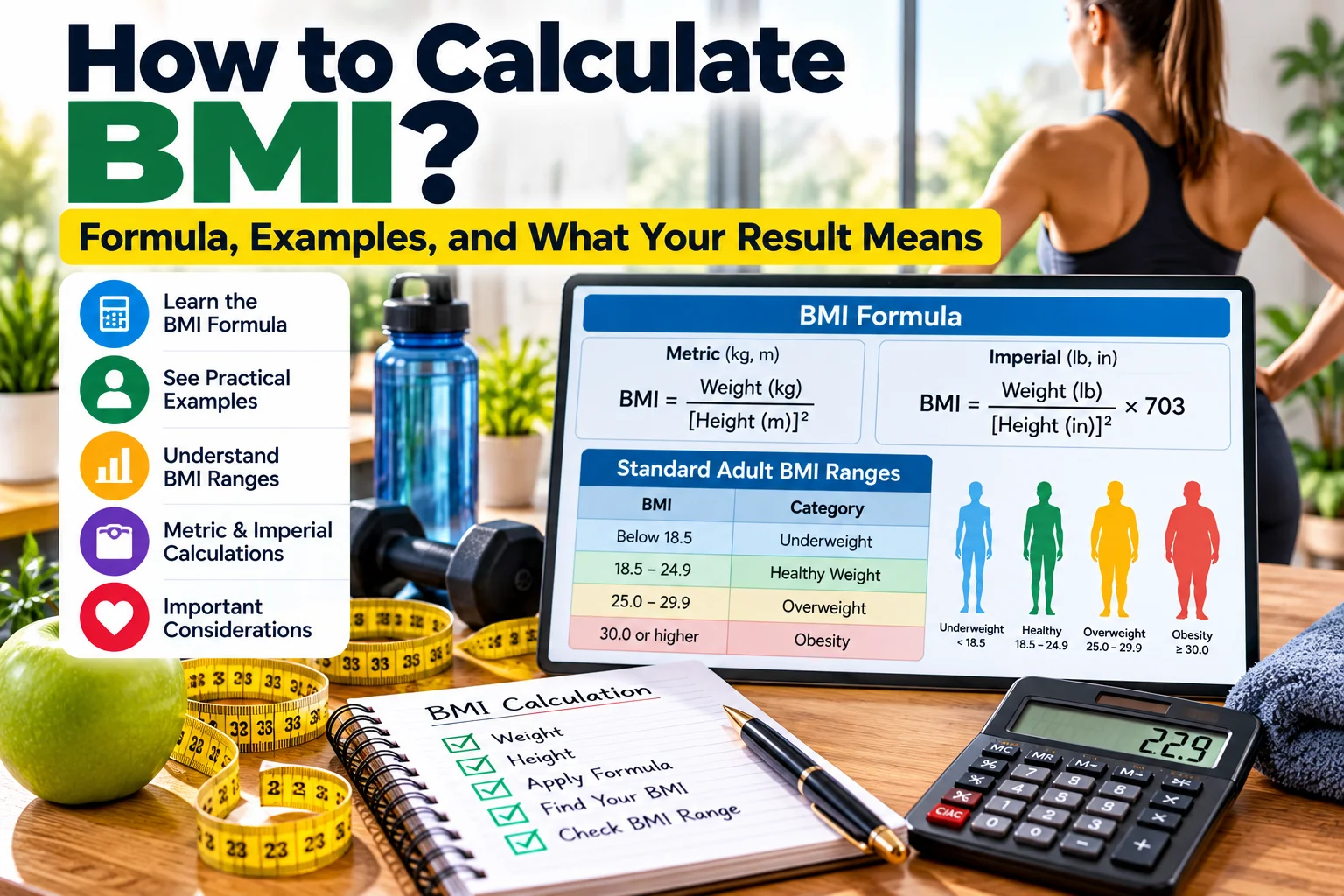
Body Mass Index, usually called BMI, is a simple calculation that compares a person's weight with their height.
It is widely used as a screening measure because it provides a quick way to group adult body weight into general ranges. The calculation requires only height and weight, making it easy to estimate with a formula or BMI calculator.
However, BMI has important limitations. It does not directly measure body fat, muscle mass, bone density, or overall health. Two people with the same BMI can have very different body compositions and health profiles.
For that reason, BMI is best understood as one general screening measure rather than a diagnosis or complete assessment of health.
What Is BMI?
BMI stands for Body Mass Index.
It expresses weight relative to height using a numerical value.
For adults, the calculation can be performed using either:
- Kilograms and meters
- Pounds and inches
Both methods are designed to produce the same BMI when the measurements are converted correctly.
For example, an adult who weighs 70 kilograms and is 1.75 meters tall has a BMI of approximately:
22.9
The number can then be compared with commonly used adult BMI ranges.
BMI Formula Using Kilograms and Meters
The metric formula is:
BMI = Weight in Kilograms ÷ Height in Meters²
In other words:
BMI = kg ÷ m²
You square the height in meters and then divide the person's weight in kilograms by that result.
Metric BMI Example
Suppose an adult weighs:
70 kg
and is:
1.75 m tall
First square the height:
1.75 × 1.75 = 3.0625
Then divide the weight by the squared height:
70 ÷ 3.0625 ≈ 22.86
Rounded to one decimal place:
BMI ≈ 22.9
BMI Formula Using Pounds and Inches
If you use pounds and inches, the formula includes a conversion factor:
BMI = (Weight in Pounds ÷ Height in Inches²) × 703
The factor of 703 adjusts the imperial measurements to the BMI scale.
Imperial BMI Example
Suppose an adult weighs:
180 lb
and is:
70 inches tall
Square the height:
70 × 70 = 4,900
Divide the weight by the squared height:
180 ÷ 4,900 ≈ 0.03673
Multiply by 703:
0.03673 × 703 ≈ 25.82
Rounded to one decimal place:
BMI ≈ 25.8
Standard Adult BMI Ranges
Commonly used BMI categories for adults are:
| BMI | General Adult Category |
|---|---|
| Below 18.5 | Underweight |
| 18.5 to 24.9 | Healthy Weight |
| 25.0 to 29.9 | Overweight |
| 30.0 or higher | Obesity |
These ranges are screening categories. They should not be interpreted as a complete assessment of an individual's health.
A person's health can be influenced by many factors that BMI does not measure.
Example: BMI of 22.9
Using the earlier example:
Weight: 70 kg
Height: 1.75 m
BMI: 22.9
On the standard adult BMI scale, 22.9 falls within the 18.5 to 24.9 range.
That places the result in the commonly labeled Healthy Weight category.
This does not mean that BMI alone can determine whether the person is healthy. It simply describes where the height-to-weight calculation falls on the standard adult BMI scale.
Example: BMI of 27.4
Suppose an adult weighs:
79 kg
and is:
1.70 m tall
Square the height:
1.70 × 1.70 = 2.89
Calculate BMI:
79 ÷ 2.89 ≈ 27.34
Rounded:
BMI ≈ 27.3
This falls within the standard adult 25.0 to 29.9 range.
Again, the category is a screening classification, not a medical diagnosis.
Why Height Is Squared in the BMI Formula
Weight naturally tends to increase as body size increases.
Simply dividing weight by height would not provide the same standardized relationship used by BMI.
The BMI formula adjusts weight relative to the square of height:
Weight ÷ Height²
This produces a number that can be compared across adults of different heights.
BMI is still only an approximation of body size and does not directly describe body composition.
How to Measure Height for BMI
Small measurement errors can change the calculated BMI, especially near category boundaries.
For a more consistent height measurement:
- Remove shoes
- Stand upright
- Use a flat surface
- Keep your feet flat
- Measure against a vertical wall where practical
- Record the measurement accurately
If using the metric formula, height must be entered in meters, not centimeters.
For example:
175 cm = 1.75 m
Entering 175 directly into a formula that expects meters would produce an incorrect result.
How to Measure Weight for BMI
Use a reasonably accurate scale and enter weight in the unit required by the formula.
For the metric formula:
Use kilograms
For the imperial formula:
Use pounds
Weight can naturally fluctuate throughout the day due to food, fluids, clothing, and other factors. For general tracking, measuring under similar conditions can make comparisons more consistent.
Converting Centimeters to Meters
If your height is measured in centimeters, divide by 100.
For example:
165 cm ÷ 100 = 1.65 m
Then square the result:
1.65 × 1.65 = 2.7225
If the person weighs 60 kg:
60 ÷ 2.7225 ≈ 22.04
BMI:
≈ 22.0
Converting Feet and Inches to Total Inches
For the imperial formula, convert height into total inches.
Suppose someone is:
5 ft 8 in
One foot equals 12 inches.
Calculate:
5 × 12 = 60 inches
Then add the remaining 8 inches:
60 + 8 = 68 inches
The BMI formula should therefore use:
68 inches
not 5.8 feet.
Example Using Feet, Inches, and Pounds
Suppose an adult weighs:
150 lb
and is:
5 ft 8 in
Convert height:
5 × 12 + 8 = 68 inches
Square the height:
68 × 68 = 4,624
Now calculate:
150 ÷ 4,624 × 703 ≈ 22.8
The estimated BMI is:
22.8
BMI Does Not Directly Measure Body Fat
One of the most important limitations of BMI is that it does not directly distinguish between different types of body mass.
The calculation uses only:
Height and weight
It does not directly measure:
- Body fat percentage
- Muscle mass
- Bone mass
- Fat distribution
- Fitness level
- Metabolic health
This means two people can have the same height, weight, and BMI while having substantially different body compositions.
BMI and Muscular Individuals
Muscle contributes to body weight.
Someone with a high amount of muscle may therefore have a BMI that falls into a higher category even when their body-fat level is relatively low.
This is one reason BMI should not be used by itself to make conclusions about an individual's body composition.
Athletes and people with substantial muscle mass may require other measurements for a more complete assessment.
BMI Does Not Show Where Body Fat Is Stored
BMI also does not indicate where body fat is located.
Two people with the same BMI may carry body fat differently.
Other measurements, such as waist circumference, may sometimes be considered alongside BMI in health assessments because fat distribution can provide additional information.
The appropriate measurements depend on the individual and the purpose of the assessment.
BMI Is a Screening Tool, Not a Diagnosis
BMI can be useful for identifying general weight patterns across groups and for providing a quick screening measurement.
It cannot diagnose conditions such as:
- Diabetes
- Heart disease
- High blood pressure
- Nutritional deficiencies
- Metabolic disorders
A BMI result should therefore not be treated as proof that someone does or does not have a health condition.
Clinical assessment may consider medical history, laboratory results, physical measurements, lifestyle, medications, age, and many other factors.
Adult BMI and Children's BMI Are Not Interpreted the Same Way
The standard adult BMI categories should not simply be applied to children and teenagers.
For children and adolescents, BMI interpretation generally considers age and sex, often using BMI-for-age growth charts or percentiles.
A BMI number that has one interpretation for an adult may have a different meaning for a growing child.
Parents or caregivers seeking information about a child's growth should use age-appropriate guidance rather than relying on adult BMI categories.
BMI During Pregnancy
Standard adult BMI calculations are not designed to describe the normal weight changes that occur during pregnancy.
Pregnancy involves changes in body weight and composition that make ordinary BMI interpretation less appropriate for tracking pregnancy weight changes.
Pregnancy-related weight guidance should be based on appropriate prenatal recommendations and individual medical advice.
Does Age Affect BMI Interpretation?
The mathematical BMI formula for adults does not change simply because an adult gets older.
However, body composition can change with age.
For example, muscle mass and fat distribution may change even if body weight remains similar.
This is another reason why the BMI number alone does not provide a complete picture of health or body composition.
Can Two People With the Same BMI Have Different Health Profiles?
Yes.
Consider two adults with the same BMI of 26.
One might exercise regularly, have substantial muscle mass, and have other health measurements within expected ranges.
Another might have less muscle mass and different metabolic or cardiovascular risk factors.
BMI alone cannot distinguish between those situations.
The number should be interpreted in context.
How Weight Changes Affect BMI
If height remains the same, gaining weight increases BMI and losing weight decreases BMI.
Suppose an adult is 1.75 m tall.
At 70 kg:
BMI ≈ 22.9
At 75 kg:
75 ÷ 3.0625 ≈ 24.5
At 80 kg:
80 ÷ 3.0625 ≈ 26.1
The height has not changed, so the BMI difference comes entirely from the change in weight.
How to Calculate a Weight From a Target BMI
The BMI formula can be rearranged mathematically:
Weight = BMI × Height²
For example, for a height of:
1.70 m
and a BMI value of:
22
Calculate:
1.70² = 2.89
Then:
22 × 2.89 = 63.58 kg
This means a weight of approximately 63.6 kg corresponds mathematically to a BMI of 22 at a height of 1.70 m.
This calculation should not be interpreted as a personalized recommendation or ideal weight. It simply reverses the BMI formula.
Why BMI Can Still Be Useful
Despite its limitations, BMI remains useful because it is:
- Simple
- Quick to calculate
- Inexpensive
- Easy to compare consistently
- Useful for population-level screening
- Based on measurements most people can obtain easily
Its usefulness depends on understanding what the number can and cannot tell you.
BMI works better as one piece of information than as a complete measure of health.
Common BMI Calculation Mistakes
Using Centimeters Instead of Meters
The metric formula requires height in meters.
Convert:
170 cm → 1.70 m
before squaring the height.
Forgetting to Square Height
The formula uses:
Height²
not simply height.
Mixing Metric and Imperial Units
Do not combine kilograms with inches or pounds with meters unless you are using a formula specifically designed for those units.
Forgetting the 703 Factor
When using pounds and inches, the commonly used imperial BMI formula includes:
× 703
Treating BMI as a Body-Fat Percentage
A BMI of 25 does not mean that a person has 25% body fat.
BMI and body-fat percentage are different measurements.
Treating a Category as a Diagnosis
BMI categories are screening classifications. They are not medical diagnoses.
Use a BMI Calculator
Manual calculations are useful for understanding how BMI works, but a calculator makes the process faster.
The ZU Calculator BMI Calculator can calculate BMI from height and weight without requiring you to work through the formula manually.
A useful BMI calculator should clearly identify the measurement units being used and provide the numerical result together with an appropriate general interpretation.
The result should still be considered in context rather than treated as a complete assessment of health.
Frequently Asked Questions
What is the formula for BMI?
Using metric units:
BMI = Weight in kg ÷ Height in meters²
Using pounds and inches:
BMI = (Weight in lb ÷ Height in inches²) × 703
What does BMI stand for?
BMI stands for:
Body Mass Index
Does BMI measure body fat?
Not directly. BMI uses only height and weight. It does not directly measure body-fat percentage or distinguish fat from muscle.
Is BMI the same for men and women?
The basic adult BMI formula is the same. However, individuals with the same BMI can have different body compositions, and BMI alone does not account for those differences.
Can athletes have a high BMI?
Yes. Because BMI does not distinguish muscle from fat, highly muscular individuals may have a higher BMI without the result directly reflecting their body-fat level.
Can children use adult BMI ranges?
Adult BMI ranges should not simply be applied to children. BMI for children and adolescents is interpreted using age-appropriate methods that account for growth and development.
Is BMI accurate for everyone?
BMI provides a general height-to-weight screening measure, but it has limitations at the individual level. Muscle mass, body composition, age, pregnancy, growth, and other factors may affect how useful the result is.
Is BMI a medical diagnosis?
No. BMI is a screening measurement and cannot diagnose a medical condition by itself.
Final Thoughts
BMI is a quick calculation that compares weight with height.
For metric measurements, the basic formula is:
BMI = Weight in Kilograms ÷ Height in Meters²
For pounds and inches:
BMI = (Weight in Pounds ÷ Height in Inches²) × 703
The calculation can be useful for general screening, but the number has clear limitations. It does not directly measure body fat, muscle mass, fat distribution, fitness, or overall health.
For that reason, BMI is best considered alongside other relevant information rather than used as a standalone judgment about an individual's health.
Health Disclaimer: This article and the BMI calculator are provided for general educational and informational purposes only. They are not a substitute for professional medical advice, diagnosis, or treatment. Individual health needs vary, and a qualified healthcare professional can provide guidance based on personal medical history and circumstances.