
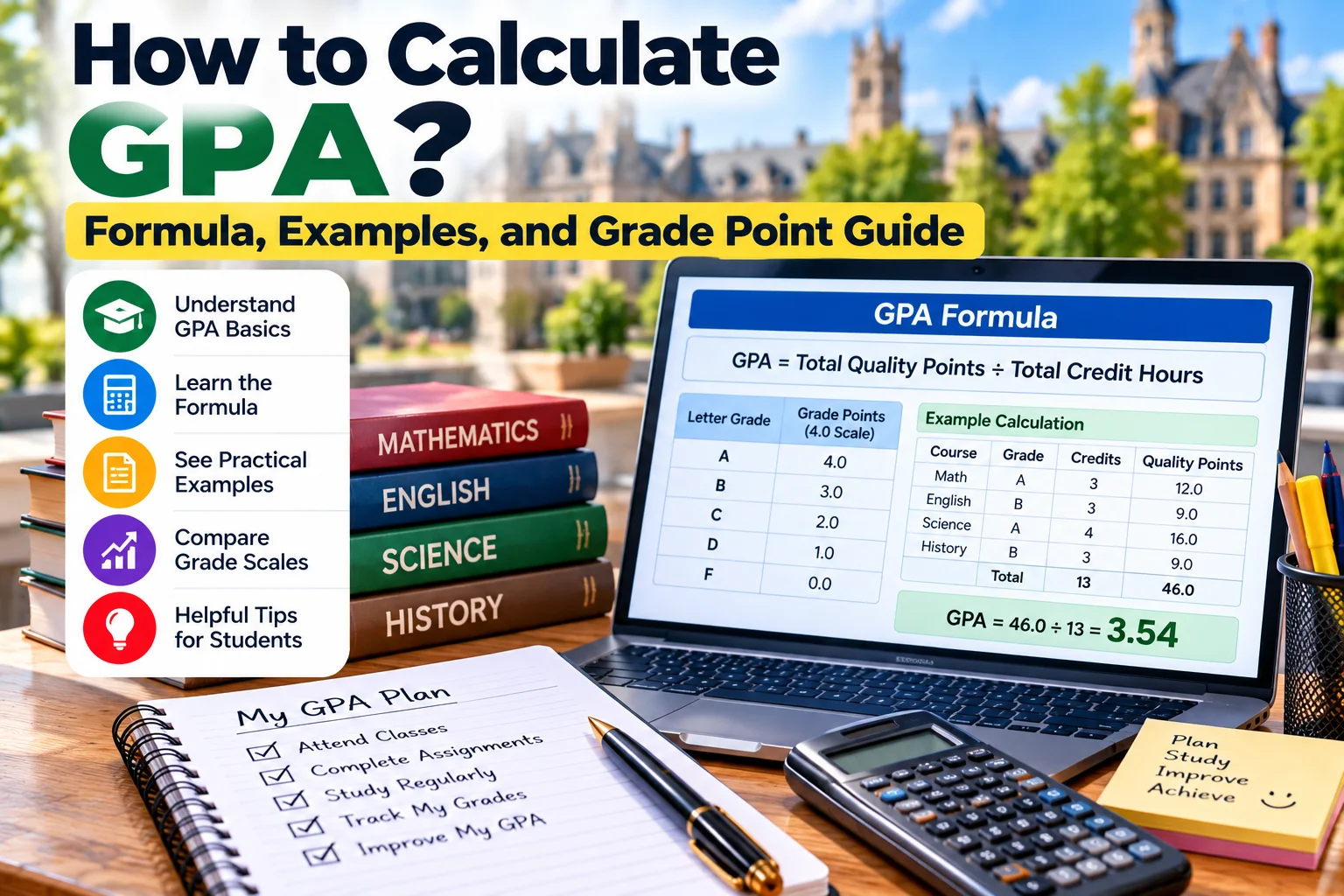
Grade Point Average, commonly called GPA, is a way of summarizing academic performance into a single number.
Instead of looking at every course grade separately, a GPA combines grade values across multiple classes. Schools, colleges, universities, scholarship programs, and other academic institutions may use GPA when reviewing a student's academic record.
The basic calculation is straightforward, but there is an important detail: not every institution calculates GPA in exactly the same way. Grade-point scales, course credits, honors classes, repeated courses, and other rules can vary.
Understanding the basic formula can help you check your GPA and see how individual courses affect your overall result.
What Is GPA?
GPA stands for Grade Point Average.
Letter grades are usually converted into numerical grade points. Those points are then averaged according to the school's grading system.
A common unweighted 4.0 scale might look like this:
| Letter Grade | Grade Points |
|---|---|
| A | 4.0 |
| B | 3.0 |
| C | 2.0 |
| D | 1.0 |
| F | 0.0 |
This is a simplified example. Some schools use plus and minus grades such as A-, B+, or C+, and the exact point values can differ.
Always use the grading scale provided by your own school or institution when calculating an official GPA.
Basic GPA Formula
If every course has equal weight, the basic formula is:
GPA = Total Grade Points ÷ Number of Courses
For example, suppose a student has four courses with these grade points:
4.0, 3.0, 4.0, 2.0
Add the grade points:
4.0 + 3.0 + 4.0 + 2.0 = 13.0
Divide by the number of courses:
13.0 ÷ 4 = 3.25
The GPA is:
3.25
This simple method works when all courses count equally.
Simple GPA Example
Suppose a student receives these grades:
| Course | Grade | Grade Points |
|---|---|---|
| English | A | 4.0 |
| Mathematics | B | 3.0 |
| Science | A | 4.0 |
| History | B | 3.0 |
| Art | C | 2.0 |
Total grade points:
4 + 3 + 4 + 3 + 2 = 16
Number of courses:
5
GPA:
16 ÷ 5 = 3.20
The student's GPA is:
3.20
Again, this example assumes every course has equal weight.
Why Course Credits Matter
At many colleges and universities, courses do not all carry the same number of credits.
A 4-credit course may contribute more to the GPA than a 1-credit course.
In that situation, simply averaging the grade points would not accurately reflect the institution's credit system.
Instead, each course's grade points are multiplied by its credit hours.
The formula becomes:
GPA = Total Quality Points ÷ Total Credit Hours
Where:
Quality Points = Grade Points × Course Credits
Credit-Weighted GPA Example
Suppose a student completes these courses:
| Course | Grade Points | Credits | Quality Points |
|---|---|---|---|
| Mathematics | 4.0 | 4 | 16.0 |
| English | 3.0 | 3 | 9.0 |
| Science | 3.0 | 4 | 12.0 |
| History | 4.0 | 3 | 12.0 |
Add the quality points:
16 + 9 + 12 + 12 = 49
Add the credits:
4 + 3 + 4 + 3 = 14
Now divide:
49 ÷ 14 = 3.50
The credit-weighted GPA is:
3.50
This method gives courses with more credits a greater effect on the final GPA.
How to Calculate Quality Points
Quality points are useful when courses have different credit values.
The formula is:
Quality Points = Grade Points × Credit Hours
For example, suppose you earn an A worth 4.0 grade points in a 3-credit course.
Quality points:
4.0 × 3 = 12
If you earn a B worth 3.0 points in a 4-credit course:
3.0 × 4 = 12
Interestingly, both courses contribute 12 quality points in this example even though the grades and credit hours are different.
What Is an Unweighted GPA?
An unweighted GPA generally uses the same grade-point scale regardless of course difficulty.
On a common 4.0 system:
A = 4.0
Whether the A came from a standard course or a more advanced course may not change the grade-point value in an unweighted system.
The purpose is to summarize grades using a consistent scale.
However, the exact rules still depend on the institution.
What Is a Weighted GPA?
Some schools use a weighted GPA to give additional points for certain advanced courses.
These might include honors, Advanced Placement, International Baccalaureate, or other advanced classes, depending on the school.
For example, one school's weighted system might award additional points for qualifying advanced courses.
A simplified illustration might look like:
| Grade | Standard Course | Advanced Course Example |
|---|---|---|
| A | 4.0 | 5.0 |
| B | 3.0 | 4.0 |
| C | 2.0 | 3.0 |
This table is only an example.
There is no universal weighted GPA scale used by every school. Some institutions add 0.5 points, some add 1.0, and others use different systems entirely.
For an official calculation, follow your school's own weighting rules.
Weighted GPA Example
Suppose a school uses the following simplified system:
- Standard A = 4.0
- Advanced A = 5.0
- Standard B = 3.0
- Advanced B = 4.0
A student takes four equally weighted courses:
| Course | Type | Grade | Weighted Points |
|---|---|---|---|
| English | Standard | A | 4.0 |
| Mathematics | Advanced | A | 5.0 |
| Science | Advanced | B | 4.0 |
| History | Standard | B | 3.0 |
Total points:
4 + 5 + 4 + 3 = 16
Divide by four courses:
16 ÷ 4 = 4.00
The weighted GPA in this example is:
4.00
The same grades could produce a lower unweighted GPA because the advanced-course bonus would not be included.
Can GPA Be Higher Than 4.0?
Yes, under some weighted grading systems.
A GPA above 4.0 does not necessarily mean there is an error.
If a school awards additional grade points for advanced courses, a student's weighted GPA may exceed 4.0.
However, an unweighted GPA based on a conventional 4.0 scale generally has 4.0 as its maximum.
This is why a GPA number should be interpreted together with the grading scale used to calculate it.
How Plus and Minus Grades Affect GPA
Some schools use only whole letter grades, while others assign different values to plus and minus grades.
For example, a grading system might assign:
| Grade | Example Grade Points |
|---|---|
| A | 4.0 |
| A- | 3.7 |
| B+ | 3.3 |
| B | 3.0 |
| B- | 2.7 |
| C+ | 2.3 |
| C | 2.0 |
These are common example values, but they are not universal.
Some institutions may use slightly different values or treat certain grades differently.
When using a GPA calculator, make sure its grading scale matches the one used by your institution.
How to Calculate Semester GPA
A semester GPA normally includes courses completed during one academic term.
Suppose you take:
| Course | Grade Points | Credits |
|---|---|---|
| Course A | 4.0 | 3 |
| Course B | 3.0 | 3 |
| Course C | 3.0 | 4 |
| Course D | 2.0 | 2 |
Calculate quality points:
Course A: 4.0 × 3 = 12
Course B: 3.0 × 3 = 9
Course C: 3.0 × 4 = 12
Course D: 2.0 × 2 = 4
Total quality points:
12 + 9 + 12 + 4 = 37
Total credits:
3 + 3 + 4 + 2 = 12
Semester GPA:
37 ÷ 12 ≈ 3.08
The semester GPA is approximately:
3.08
How to Calculate Cumulative GPA
Cumulative GPA generally combines academic performance across multiple terms.
If you know the total quality points and total credits from all applicable terms, use:
Cumulative GPA = Total Quality Points ÷ Total GPA Credits
For example:
Previous quality points: 90
Previous credits: 30
This semester:
Quality points: 42
Credits: 12
Combined quality points:
90 + 42 = 132
Combined credits:
30 + 12 = 42
Cumulative GPA:
132 ÷ 42 ≈ 3.14
The new cumulative GPA is approximately:
3.14
Why You Should Not Simply Average Semester GPAs
Suppose your first semester GPA is:
3.50
and your second semester GPA is:
3.00
It might seem that your cumulative GPA should automatically be:
3.25
That is only correct if both semesters carry the same GPA credit weight.
For example, if one semester includes 18 credits and another includes 9 credits, the 18-credit semester contributes more to the cumulative GPA.
The more accurate method is to combine the underlying quality points and credits rather than simply averaging the semester GPA numbers.
Example With Different Semester Credit Loads
Suppose:
Semester 1: 3.50 GPA over 18 credits
Quality points:
3.50 × 18 = 63
Semester 2:
3.00 GPA over 12 credits
Quality points:
3.00 × 12 = 36
Combined quality points:
63 + 36 = 99
Combined credits:
18 + 12 = 30
Cumulative GPA:
99 ÷ 30 = 3.30
Simply averaging 3.50 and 3.00 would give 3.25, which would be incorrect in this example because the semesters have different credit loads.
How a New Grade Can Affect Your GPA
The effect of one new course depends partly on how many credits you have already completed.
A student with only a few completed courses may see a noticeable GPA change from one new grade.
A student who has already completed many credits may experience a smaller change because the new course represents a smaller portion of the total academic record.
For example, adding one 3-credit course to 12 existing credits has a much greater proportional effect than adding the same course to 100 existing credits.
How to Estimate a Future GPA
You can estimate a future cumulative GPA if you know:
- Current GPA
- Current completed credits
- Expected grades
- Credits for upcoming courses
First estimate current quality points:
Current Quality Points = Current GPA × Current GPA Credits
Then calculate expected quality points for the new courses.
Add both sets together and divide by the new total number of credits.
Example
Current GPA:
3.20
Completed credits:
30
Current quality points:
3.20 × 30 = 96
Suppose you expect to complete another 12 credits with 42 quality points.
New total quality points:
96 + 42 = 138
New total credits:
30 + 12 = 42
Estimated cumulative GPA:
138 ÷ 42 ≈ 3.29
The estimated GPA would be approximately:
3.29
This is only a planning estimate. Your institution's official calculation may include additional rules.
Do Pass/Fail Courses Affect GPA?
It depends on the institution.
Some pass/fail courses may count toward earned credits without contributing grade points to GPA. Other schools may use different rules.
Similarly, grades such as:
- Pass
- Fail
- Withdraw
- Incomplete
- Audit
may be treated differently depending on institutional policy.
Do not automatically assign grade points to these grades unless you know how your school handles them.
What Happens When You Repeat a Course?
Repeated-course policies vary considerably.
A school might:
- Replace the earlier grade
- Include both grades
- Average repeated attempts
- Apply special grade-forgiveness rules
- Keep both grades on the transcript while using only one in GPA calculations
Because these policies can significantly change the result, a general GPA formula cannot determine how your institution handles repeated courses.
Check your school's academic policy when calculating an official cumulative GPA.
GPA vs. Percentage Grade
A GPA and a percentage grade are not necessarily directly interchangeable.
For example, you should not automatically assume that:
80% = 3.2 GPA
by simply multiplying 80% by 4.
Schools may use specific grade boundaries to convert percentages or letter grades into grade points.
A percentage-to-GPA conversion should therefore follow the grading system of the institution involved.
GPA vs. Class Rank
GPA measures academic performance according to a grading system.
Class rank compares a student's academic standing with other students in the same group, where a school uses class ranking.
Two students could have similar GPAs but different class ranks depending on the performance of other students.
Likewise, differences in weighted courses may affect ranking at institutions that use weighted GPA.
What Is a Good GPA?
There is no single GPA that is appropriate to label as “good” in every situation.
The meaning of a GPA depends on factors such as:
- Grading scale
- School or university
- Course difficulty
- Academic program
- Scholarship requirements
- Admissions requirements
- Employer requirements
- Weighted or unweighted calculation
A GPA that satisfies one program's requirement may not satisfy another.
When GPA matters for an application, scholarship, or academic program, compare your result with the specific published requirements rather than relying on a universal benchmark.
Common GPA Calculation Mistakes
Treating Every Course as Equal When Credits Differ
If courses have different credit hours, calculate quality points rather than taking a simple average.
Using the Wrong Grade-Point Scale
A calculator using one school's grading scale may not match another institution's official GPA.
Mixing Weighted and Unweighted GPA
A weighted GPA should not be compared directly with an unweighted GPA without understanding the scales used.
Averaging Semester GPAs Without Considering Credits
If semesters have different credit loads, a simple average can produce an incorrect cumulative GPA.
Assuming Every Course Counts Toward GPA
Pass/fail courses, withdrawals, repeated courses, and other special grades may be treated differently.
Rounding Too Early
Keep several decimal places during intermediate calculations and round only the final GPA when possible.
For example:
3.2764
might be displayed as:
3.28
if the institution reports GPA to two decimal places.
Use a GPA Calculator
Calculating GPA manually helps you understand how grades and credits affect the result, but it can become time-consuming when many courses are involved.
The ZU Calculator GPA Calculator can help you enter course grades and credit values and calculate the resulting GPA more quickly.
It can also be useful for testing different scenarios.
For example, you could estimate how earning an A, B, or C in an upcoming course might affect your overall GPA.
For official academic purposes, always compare the calculator settings with your institution's grading and credit policies.
Frequently Asked Questions
What is the basic GPA formula?
For equally weighted courses:
GPA = Total Grade Points ÷ Number of Courses
For credit-weighted courses:
GPA = Total Quality Points ÷ Total GPA Credits
What are quality points?
Quality points are calculated by multiplying the grade-point value of a course by its credit hours.
Quality Points = Grade Points × Credits
Can my GPA be higher than 4.0?
It can be under some weighted grading systems. Advanced courses may receive additional grade points, allowing a weighted GPA to exceed 4.0.
Is a 4.0 GPA always the maximum?
Not necessarily. It is generally the maximum on a traditional unweighted 4.0 scale, but weighted systems may allow higher values.
How do I calculate cumulative GPA?
Add the applicable quality points from all included terms and divide by the total applicable GPA credits.
Should I average my semester GPAs?
Only if the semesters have equal weighting. If they contain different numbers of credits, combine quality points and credits instead.
Does a failed course affect GPA?
It often can, but the exact treatment depends on the institution's grading and repeat-course policies.
Do withdrawals affect GPA?
Policies vary. Some withdrawal grades may not contribute grade points, while other types of withdrawal may be treated differently. Check your institution's rules.
Can I convert a percentage directly to GPA?
Not reliably without knowing the grading scale. Different institutions may convert percentages to letter grades or grade points differently.
Final Thoughts
Calculating GPA becomes much easier once you understand the relationship between grades, grade points, and course credits.
For equally weighted courses, the calculation may be as simple as averaging grade points.
When credit hours differ, use:
GPA = Total Quality Points ÷ Total GPA Credits
The most important point is that GPA systems are not completely universal. Weighted courses, plus and minus grades, repeated classes, pass/fail courses, and institutional policies can all affect the official calculation.
A GPA calculator can provide a useful estimate and help you plan different grade scenarios, but your school's official academic record remains the authoritative source for your GPA.
Note: The examples in this guide are for educational purposes and use simplified grading systems. Always use your school, college, university, or academic program's official grading scale and GPA policies when an official result is required.