
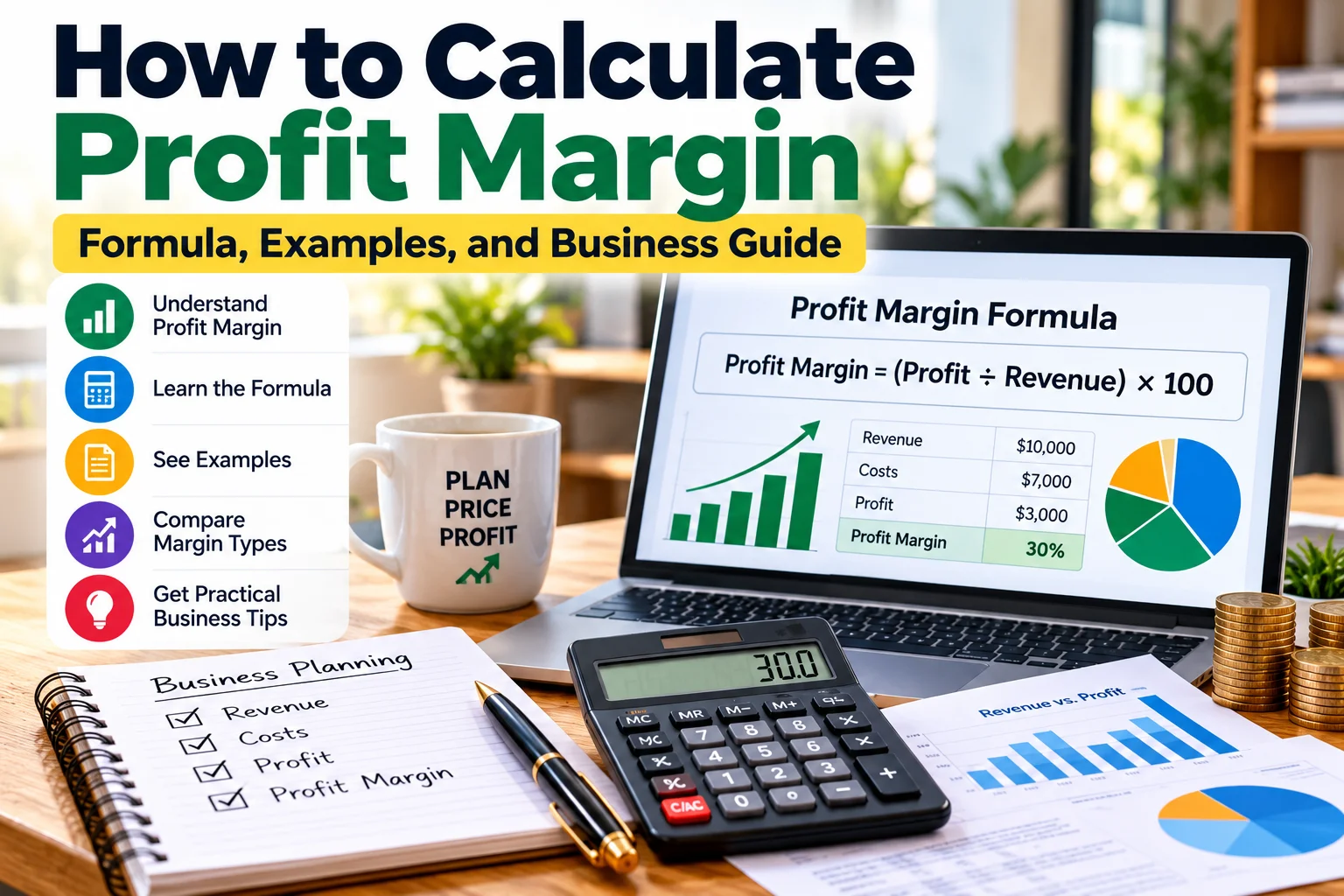
Profit margin is one of the most useful numbers for understanding how much money a business actually keeps from its sales.
A business can generate plenty of revenue and still make very little profit if its costs are too high. That is why looking at sales alone does not tell the full story. Profit margin puts profit into context by showing it as a percentage of revenue.
Whether you run a small business, sell products online, provide freelance services, or simply want to understand business finances better, knowing how to calculate profit margin can help you evaluate pricing, expenses, and overall performance.
The basic calculation is straightforward once you understand which numbers to use.
What Is Profit Margin?
Profit margin measures how much profit remains from revenue after certain costs have been deducted.
It is usually expressed as a percentage.
For example, if a business earns $10,000 in revenue and keeps $2,000 as profit, its profit margin is:
20%
This means that for every $1 of revenue, approximately $0.20 remains as profit based on the costs included in that calculation.
Different types of profit margin include different expenses, so it is important to know whether you are calculating gross, operating, or net profit margin.
Basic Profit Margin Formula
The general formula is:
Profit Margin = (Profit ÷ Revenue) × 100
Before using the formula, calculate profit:
Profit = Revenue − Costs
You can therefore write the complete calculation as:
Profit Margin = ((Revenue − Costs) ÷ Revenue) × 100
Simple Profit Margin Example
Suppose a small business generates:
Revenue: $10,000
Its relevant costs are:
$7,000
First calculate profit:
$10,000 − $7,000 = $3,000
Then calculate the profit margin:
($3,000 ÷ $10,000) × 100 = 30%
The business has a 30% profit margin based on the costs included in this example.
In simple terms, it keeps $0.30 in profit for every $1 of revenue.
Revenue Is Not the Same as Profit
Revenue is the total amount generated from sales before expenses are deducted.
Profit is what remains after the relevant expenses are subtracted.
For example:
| Item | Amount |
|---|---|
| Revenue | $50,000 |
| Costs | $40,000 |
| Profit | $10,000 |
| Profit Margin | 20% |
A business might describe $50,000 as its sales or revenue, but that does not mean it earned $50,000 in profit.
After $40,000 in costs, only $10,000 remains in this simplified example.
Gross Profit Margin
Gross profit margin focuses primarily on the direct cost of producing or purchasing the goods or services being sold.
The formula is:
Gross Profit = Revenue − Cost of Goods Sold
Then:
Gross Profit Margin = (Gross Profit ÷ Revenue) × 100
Cost of Goods Sold is commonly abbreviated as COGS.
Depending on the business, COGS may include costs such as:
- Materials
- Inventory purchases
- Direct manufacturing costs
- Certain direct labor costs
- Other costs directly associated with producing the goods sold
Gross Profit Margin Example
Suppose an online store generates:
Revenue: $80,000
Its Cost of Goods Sold is:
$48,000
Gross profit is:
$80,000 − $48,000 = $32,000
Gross profit margin is:
($32,000 ÷ $80,000) × 100 = 40%
The store's gross profit margin is 40%.
This does not necessarily mean the business keeps 40% as final profit. Other operating expenses, taxes, interest, and additional costs may still need to be deducted.
Operating Profit Margin
Operating profit margin goes further than gross margin.
It considers operating expenses required to run the business, such as certain salaries, rent, marketing, administrative expenses, and other operating costs.
A simplified formula is:
Operating Profit Margin = (Operating Profit ÷ Revenue) × 100
Suppose a business has:
Revenue: $100,000
Gross Profit: $45,000
Operating Expenses: $25,000
Operating profit would be:
$45,000 − $25,000 = $20,000
Operating profit margin:
($20,000 ÷ $100,000) × 100 = 20%
The operating margin is 20%.
This provides a broader picture of business performance than gross margin because more of the costs involved in running the business have been included.
Net Profit Margin
Net profit margin looks at the amount left after all applicable expenses have been accounted for.
Depending on the financial statement, these may include operating expenses, interest, taxes, and other relevant costs.
The formula is:
Net Profit Margin = (Net Profit ÷ Revenue) × 100
Suppose a business generates:
Revenue: $100,000
After all applicable expenses, it has:
Net Profit: $12,000
The net profit margin is:
($12,000 ÷ $100,000) × 100 = 12%
The business therefore keeps approximately 12 cents of net profit for every $1 of revenue.
Gross Margin vs. Net Margin
Gross and net margins answer different questions.
| Margin | What It Generally Measures |
|---|---|
| Gross Profit Margin | Profit after direct cost of goods or services |
| Operating Profit Margin | Profit after operating expenses |
| Net Profit Margin | Profit after all applicable expenses |
A company might have a strong gross margin but a much lower net margin if rent, salaries, advertising, interest, taxes, or other expenses are significant.
That is why it is important to specify which profit margin you are discussing.
Profit Margin vs. Markup
Profit margin and markup are often confused, but they are not the same calculation.
Profit margin compares profit with selling price or revenue.
Markup compares profit with cost.
Suppose a product costs:
$70
You sell it for:
$100
Profit is:
$100 − $70 = $30
Profit margin:
($30 ÷ $100) × 100 = 30%
Markup:
($30 ÷ $70) × 100 ≈ 42.86%
So in this example:
Profit Margin = 30%
Markup ≈ 42.86%
Using the terms interchangeably can lead to pricing mistakes.
How to Calculate a Selling Price From a Target Margin
Sometimes you already know the product cost and want to determine the selling price needed for a specific gross margin.
A useful formula is:
Selling Price = Cost ÷ (1 − Target Margin)
The target margin must be expressed as a decimal.
Suppose a product costs:
$60
You want a:
25% margin
Convert 25% to 0.25:
Selling Price = $60 ÷ (1 − 0.25)
Selling Price = $60 ÷ 0.75
Selling Price = $80
Check the result:
Profit:
$80 − $60 = $20
Margin:
($20 ÷ $80) × 100 = 25%
So a selling price of $80 produces a 25% gross margin in this simplified example.
Why You Cannot Simply Add the Target Margin to Cost
Suppose a product costs $60 and you want a 25% profit margin.
It might seem logical to add 25% to the cost:
$60 × 1.25 = $75
But the resulting margin is not 25%.
Profit:
$75 − $60 = $15
Margin:
($15 ÷ $75) × 100 = 20%
Adding 25% to cost creates a 25% markup, not a 25% margin.
To achieve a true 25% margin in this example, the selling price needs to be $80.
This distinction is especially important when setting prices.
Profit Margin Example for a Freelancer
Profit margin is not only useful for businesses that sell physical products.
Freelancers and service providers can also use it to understand how much of their income remains after business expenses.
Suppose a freelance designer earns:
Monthly Revenue: $6,000
Business expenses include:
| Expense | Amount |
|---|---|
| Software | $300 |
| Advertising | $400 |
| Contractors | $1,000 |
| Internet and business services | $200 |
| Other business expenses | $300 |
| Total | $2,200 |
Profit before any additional applicable expenses:
$6,000 − $2,200 = $3,800
Profit margin:
($3,800 ÷ $6,000) × 100 ≈ 63.33%
This example gives the freelancer a clearer picture than simply looking at $6,000 in monthly revenue.
The exact expenses included will depend on what type of margin the freelancer is trying to measure.
Profit Margin Example for an Online Product
Suppose an online seller sells a product for:
$50
The relevant direct costs are:
Product cost: $22
Packaging: $3
Direct transaction or selling costs: $5
Total relevant costs:
$30
Profit:
$50 − $30 = $20
Profit margin:
($20 ÷ $50) × 100 = 40%
The margin is 40% based on those included costs.
However, if the seller also has advertising, staff, software, rent, taxes, returns, or other business expenses, the final net margin may be lower.
How Discounts Affect Profit Margin
Discounts reduce the selling price while many costs remain unchanged.
That means even a relatively small discount can have a noticeable effect on profit.
Suppose a product normally sells for:
$100
Its cost is:
$70
Normal profit:
$30
Normal margin:
30%
Now suppose the selling price is discounted by 10%:
New Selling Price = $90
The cost remains $70.
New profit:
$90 − $70 = $20
New profit margin:
($20 ÷ $90) × 100 ≈ 22.22%
The selling price fell by 10%, but the margin dropped from 30% to approximately 22.22%.
This is why businesses should consider the effect on profit, not only the percentage discount offered to customers.
How Increasing Costs Affect Margin
Suppose a product sells for $100 and originally costs $60.
Profit:
$40
Margin:
40%
If the cost increases to $70 but the selling price remains $100:
Profit becomes:
$30
New margin:
30%
A cost increase can therefore reduce margin even when revenue per sale stays exactly the same.
Monitoring margins can help identify situations where pricing may need to be reviewed.
Can a Profit Margin Be Negative?
Yes.
A negative profit margin occurs when expenses exceed revenue.
Suppose a business generates:
Revenue: $20,000
But its relevant expenses total:
$24,000
Profit:
$20,000 − $24,000 = −$4,000
Profit margin:
(−$4,000 ÷ $20,000) × 100 = −20%
The negative margin indicates a loss for the period under the expenses included in the calculation.
What Is a Good Profit Margin?
There is no single profit margin that is automatically good for every business.
Margins can vary substantially based on:
- Industry
- Business model
- Product type
- Location
- Competition
- Pricing strategy
- Labor requirements
- Overhead
- Business size
- Stage of growth
A grocery retailer, software company, construction business, freelancer, and restaurant may operate with very different cost structures.
Because of this, comparing your margin with an unrelated industry can be misleading.
It can be more useful to compare margins with relevant industry benchmarks, similar businesses, and your own historical performance.
How to Improve Profit Margin
There are two basic sides of the profit equation:
Revenue and costs
A business may improve margin by increasing revenue without increasing costs at the same rate, reducing unnecessary costs, or using a combination of both.
Possible areas to examine include:
- Pricing
- Supplier costs
- Product mix
- Discounts
- Packaging
- Shipping
- Advertising efficiency
- Software subscriptions
- Payment processing costs
- Waste and returns
- Labor efficiency
- Administrative expenses
Reducing costs indiscriminately is not always beneficial. Cutting expenses that affect product quality, customer service, or future growth may create other problems.
The goal is to understand which costs create value and which can be managed more efficiently.
Why Tracking Margin Over Time Matters
A single margin calculation provides a snapshot.
Tracking margin regularly can reveal trends.
For example, imagine a business records these net margins:
| Period | Net Profit Margin |
|---|---|
| Q1 | 18% |
| Q2 | 17% |
| Q3 | 14% |
| Q4 | 11% |
Revenue might even be increasing during this period, but the declining margin could indicate that expenses are growing faster than sales.
Without monitoring margin, that change may be less obvious.
Common Profit Margin Calculation Mistakes
Using Profit Instead of Revenue in the Denominator
Profit margin divides profit by revenue, not by cost.
The standard formula is:
Profit ÷ Revenue × 100
Dividing profit by cost calculates markup instead.
Mixing Gross and Net Profit
Do not compare gross profit margin from one period with net profit margin from another as if they measure exactly the same thing.
Make sure you are comparing the same type of margin.
Forgetting Important Costs
Leaving out significant expenses can make profitability appear stronger than it really is.
The costs included should match the type of margin being calculated.
Confusing Cash With Profit
Cash flow and accounting profit are related but different concepts.
Having cash in the bank does not automatically mean a business has earned the same amount as profit.
Comparing Unrelated Businesses
Different industries can have very different normal cost structures and margins.
A meaningful comparison should account for the type of business and the type of margin being measured.
Use a Profit Margin Calculator
You can calculate profit margin manually, but a calculator is useful when comparing different prices, costs, or target margins.
The ZU Calculator Profit Margin Calculator can help you quickly compare scenarios without repeating the formulas manually.
For example, you can test what happens when:
- Product cost increases
- Selling price changes
- A discount is applied
- You want to reach a specific margin
- Revenue or expenses change
This can be particularly useful when reviewing pricing decisions before making them.
Frequently Asked Questions
What is the basic profit margin formula?
The general formula is:
Profit Margin = (Profit ÷ Revenue) × 100
And:
Profit = Revenue − Costs
What is the difference between profit and profit margin?
Profit is an amount of money.
Profit margin expresses that profit as a percentage of revenue.
For example, $2,000 is a profit amount, while 20% is a profit margin.
Is profit margin the same as markup?
No.
Margin compares profit with revenue or selling price.
Markup compares profit with cost.
They can produce very different percentages from the same transaction.
Can profit margin be over 100%?
When profit margin is calculated using the standard formula of profit divided by revenue, a conventional positive margin generally does not exceed 100% because profit is derived from that revenue after costs. Markup, however, can exceed 100%.
Why is my net margin lower than my gross margin?
Gross margin generally deducts direct costs associated with producing or purchasing what was sold.
Net margin includes a broader range of expenses, so it is normally lower when additional expenses are present.
Should freelancers calculate profit margin?
It can be useful. Freelancers have business expenses too, including software, contractors, advertising, equipment, payment fees, and other costs. Tracking margin can provide a clearer picture of how much income remains after those expenses.
How often should a business calculate profit margin?
The appropriate frequency depends on the business. Some businesses monitor margins monthly, quarterly, annually, or even by individual product or project.
Final Thoughts
Profit margin turns revenue and costs into a percentage that is easier to compare across products, projects, or time periods.
The basic formula is simple:
Profit Margin = (Profit ÷ Revenue) × 100
But the meaning of the result depends on which costs have been included.
Gross margin helps evaluate direct costs, operating margin considers the costs of running the business, and net margin provides a broader view after applicable expenses.
For business owners and freelancers, regularly reviewing margins can make pricing and cost decisions more informed and reveal changes that revenue figures alone may not show.
Note: The examples in this guide are simplified for educational purposes. Actual accounting treatment, taxes, deductible expenses, and financial reporting requirements vary by business and jurisdiction. For accounting, tax, or financial decisions specific to your situation, consider consulting an appropriately qualified professional.